
Halo: Campaign Evolved is such a strong reimagining of a beloved classic that it occasionally struggles to define exactly what kind of reimagining it wants to be. At times, it’s committed to faithfully recreating the original, while at others it seems hellbent on carving out an identity of its own. Either way, it’s an exceptionally polished experience that more than earns its shockingly tame price tag.
What’s Halo: Campaign Evolved?
Halo: Campaign Evolved is a first-person shooter developed by Halo Studios, formerly 343 Studios, and published by Xbox Game Studios. It’s a modernized remake of the original 2001 classic Halo: Combat Evolved.
The game follows Master Chief and his AI companion, Cortana, after crash landing on a ring-shaped alien world, where they must rally human survivors to fight off a hostile alien alliance known as the Covenant.
Although it retains the sandbox combat of the Xbox classic, the remake introduces enhanced visuals, expanded co-op options, and brand new prequel missions that further explore the events leading up to the original adventure. You’re getting 10 original missions, 3 bonus missions, 17 weapons, re-recorded voice acting, 2-player split-screen co-op on console, 4-player online co-op, and cross-platform multiplayer co-op.



Pretty Doesn’t Mean Perfect

Saying the original Halo was influential to modern FPS games is a massive understatement. It was one of the defining games of the genre, helping establish many of the conventions that console shooters still use today. Alongside later franchises like Call of Duty and Battlefield, it shaped the modern FPS landscape. Halo: Combat Evolved is arguably the most important console FPS ever made, and its success is easily the main reason Xbox became such a massive gaming platform.
So in an era where the industry seems increasingly obsessed with remakes and remasters, it’s not really a surprise that Halo: Combat Evolved got one of its own. Sure, Halo already got Anniversary, but Campaign Evolved is an entirely different beast. More than a visual overhaul, it’s an attempt to rebuild Combat Evolved into what Halo Studios believes is its definitive modern form, and as a game, it’s an excellent one.
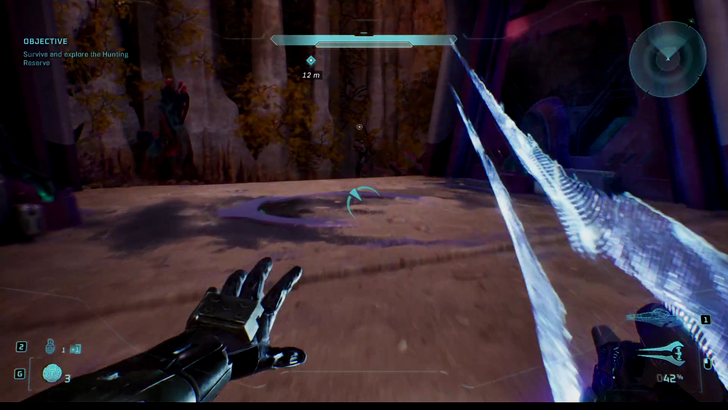
But Campaign Evolved isn’t interesting just because it’s good. It’s interesting because it sits in that awkward space between preservation and reinvention. The combat loop is hectic and fun, the audiovisuals are almost immersive, sometimes annoyingly so, and the expanded co-op options help make up for the lack of multiplayer. Yet at the same time, modern and series-controversial additions like sprint fundamentally step on the game’s power fantasy, while Sgt. Johnson comes across as noticeably more restrained than in the original.
The scope of the project makes sense, though. As the title implies, Halo Studios set out to build the definitive edition of the original game’s campaign, and for the most part, they pulled it off. There are definitely a few caveats, mostly stemming from modern gameplay decisions that make it feel like the developers were hedging their bets. Fortunately, this doesn’t extend to the story.
Battle Buddies of Old
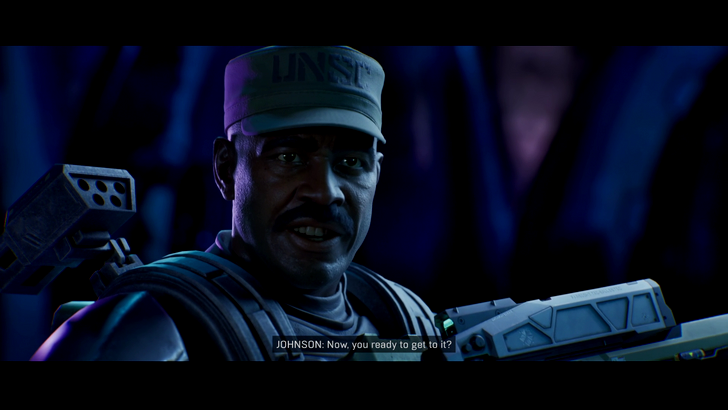
The original campaign is mostly untouched. It’s a very faithful retelling of Combat Evolved, just running on an engine that eats your hardware alive. There are still Covenant ranks to smash through, The Flood to clean up, and plenty of mystique hiding everything under a thin veil of wonder.
What Campaign Evolved does add is a three-mission bonus campaign that explores Sgt. Avery Johnson’s relationship with the Master Chief. While much smaller in scale than the main campaign, it effectively shows how well the two work together and bounce off each other, even in the middle of heavy suppressive fire.
The chemistry is there; the campaign just doesn’t spend enough time with it. Right when Johnson and Chief start feeling like genuine partners rather than soldiers sharing the same battlefield, the story’s already wrapping up. Halo: Campaign Evolved’s missions aren’t that long to begin with, so only having three of them to flesh out one of the series’ most iconic battle buddies feels sorely lacking. And that shortage of content culminates in the ending’s severe lack of payoff.
If it were up to me, I’d at least double the mission count. That way, the arc would have more room to breathe without overshadowing the bigger narrative of the original campaign.
We Always Want to Keep Shooting
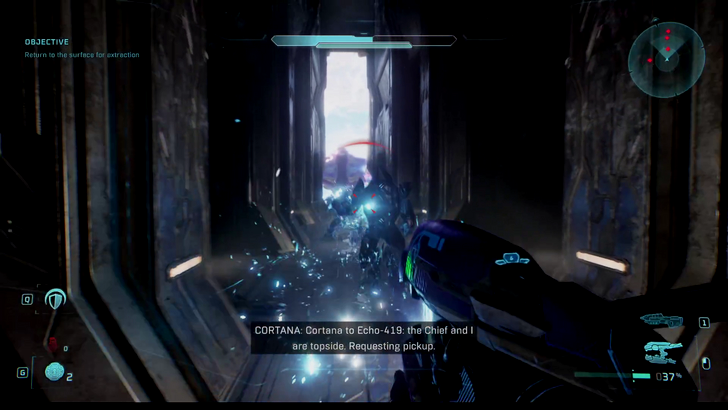
When it comes to the core combat features, most of it has thankfully been left untouched. The core gameplay is still that very repetitive but extremely fun loop of shooting until you run out of ammo, “borrowing” your dead enemy’s gun, and then shooting some more. Oh, and you occasionally throw grenades and die to those chucked at your face, sometimes simultaneously.
Yeah, it’s repetitive, but that’s exactly the point. In fact, this core gameplay loop has withstood the test of time and even thrived for over two decades now, and it’s still addictive. After all, some of the best games are built on the philosophy that sometimes you just want to shoot things dead for six hours straight.
So why, oh why did they add sprint here? Sure, Halo’s had it for a few games now, but not in the original Combat Evolved that this game is based on. It still feels sorely out of place in these kinds of games where shooting is always the correct choice, and you can’t do so while sprinting. Look at Doom 2016 and Eternal for modern examples; those games leaned so hard on the power fantasy that the Doom Slayer was always at maximum speed, regardless of whether he’s shooting or not.
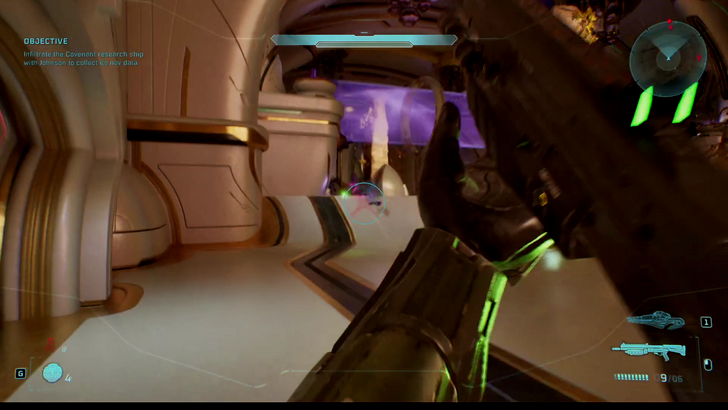
No, dash is a different thing.
Halo’s combat works because nearly every situation asks you how you can shoot your way through it. Just having the option to sprint dilutes your options away from that. Ironically, simply making Master Chief move faster all the time would’ve preserved that power fantasy way better than having him suddenly remember he can run.
Like, there was a mission in the bonus campaign that forced you to fight two Hunters on a platform. Ideally, I would’ve just tried weaving around them, baiting their melee attacks while firing at their exposed bits. Instead, because sprint was there, my Apex Legends brain took over. I spent the next few minutes doing an incredibly un-fun game of cat-and-mouse, luring them into a corridor one at a time while I shot at them in-between their much more devastating ranged attacks.
It Looks and Sounds Amazing. Annoyingly So, Sometimes.

Ah, Unreal Engine 5. Some love it, some hate it. I personally don’t care as long as it doesn’t make everything look like it has a layer of car wax on it. But in Campaign Evolved’s case, it did a wonderful job making everything look as wondrous and horrifying, The Library for example, as they should be. At the cost of making your hardware cry, that is.
The audio design is excellent. You can often tell when enemies are approaching, what they’re about to do, or when a grenade is about to send you back to a checkpoint just from the sound alone. Plus, the guns actually sound like they’re punching back on your chest, too, instead of just on your shoulders. Heck, even the Plasma Pistol and Magnum, still gloriously overtuned here, sound like they’re giving you wrist cramps from across the speakers.
Its audiovisuals combine for a truly immersive experience of shooting and getting blown up. Especially once you face The Flood, it gets rather creepy really quickly because both your eyes and ears convince you that you’re never really safe. The effectiveness of the genre shift from sci-fi action to creature feature horror here is such that even the original can’t compare.
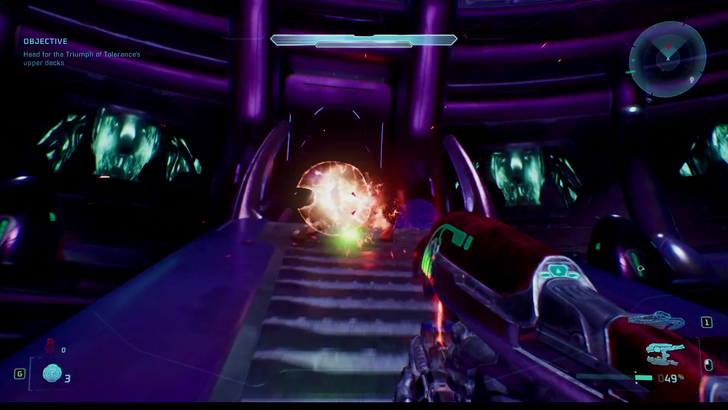
And that’s exactly why it can get so annoying at times. See, the original Halo has some of the best missions in FPS history, but it also has some of the most frustrating. Hell, some of the bonus areas have rather terrible stage designs. Some levels are notoriously repetitive, sending you through the same corridors and rooms while throwing the same enemies and weapons at you over and over. Campaign Evolved trims some of that fat, but it can’t remove it entirely without fundamentally changing the original game.
By an almost laughable stroke of irony, the remake’s greatest strength becomes one of its most obvious weaknesses. By making every hallway, firefight, and impending death-by-grenade so much more convincing, it also makes the campaign’s most repetitive sections much harder to mentally shrug off.
The Bottom Line
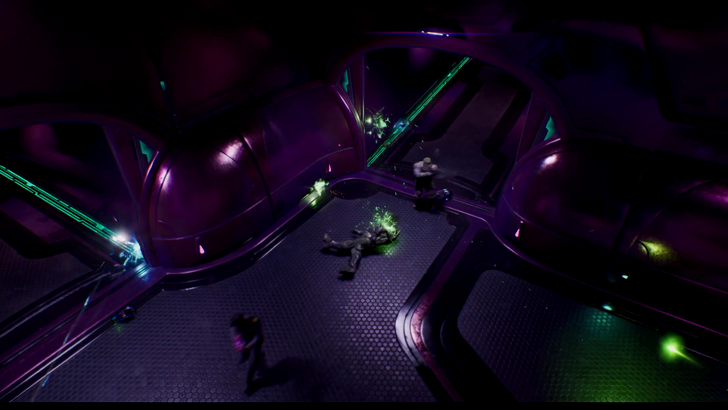
For a relatively tame 50 dollars per copy, getting the entire campaign of the original Halo is a pretty good deal. The leap to Unreal Engine looks absolutely amazing, the pristine audio punches back hard, especially when a grenade explodes on your face, and the core combat loop is just as hectic and fun as ever. You do have to put up with its legacy baggage, though, like the repetitive level design.
Sure, it doesn’t have multiplayer, but it does have expanded co-op options for you and your friends, which I don’t have, to mess around with. And it’s going to do wonders considering just how hellish, and fun, the higher difficulty modes are.
That does beg the question, though. Why can’t Halo Studios just use all these resources and make a new Halo game?




Final Verdict
Halo: Campaign Evolved delivers a great experience with a score of 88/100.